
What Is CCNA? A Complete Beginner's Guide to Cisco CCNA 200-301 (2026–27)
If you want a career in networking, CCNA is usually the first certification people tell you to get. But what does it actually cover, how hard is the exam, and how should you prepare? This guide answers those questions in plain language, so you can decide whether CCNA is the right next step for you.
What is CCNA?
CCNA stands for Cisco Certified Network Associate. It is Cisco's associate-level certification and proves that you understand how modern networks are built, run and secured. You earn it by passing a single exam, 200-301 CCNA (Implementing and Administering Cisco Solutions).
Although the certificate carries Cisco's name, most of what you learn applies to any network: IP addressing, switching, routing, wireless, security basics and automation. That is why CCNA is valued even by companies that use other vendors.
Who should take CCNA?
- Students in BE, BTech, BSc, BCA, diploma or MCA who want to start a networking career.
- Hardware and desktop support engineers who want to move into network roles.
- Working professionals in IT who need strong networking basics for cloud, security or server work.
- Anyone planning to study firewalls (FortiGate, Palo Alto, Check Point) or CCNP later. CCNA gives you the foundation those courses assume.
There is no formal prerequisite. You do not need prior certification, although basic computer knowledge helps.
CCNA 200-301 exam at a glance
| Exam code | 200-301 CCNA |
|---|---|
| Duration | 120 minutes |
| Exam fee | US$300 plus tax (paid while booking with Pearson VUE) |
| Languages | English and Japanese |
| Question types | Multiple choice, drag and drop, and simulation-style questions |
| Number of questions and pass mark | Not officially published by Cisco |
| Current version | v1.1, available until 2 February 2027 |
Important change in 2027: Cisco has published a new CCNA v2.0 blueprint. From 3 February 2027 only v2.0 can be taken. The exam keeps the same 200-301 code and 120-minute length, but the domains are reorganised and new AI-related content is added. If you plan to write the exam after early February 2027, prepare for v2.0. Our classes cover the core networking skills that both versions test.
What the CCNA syllabus covers
The current v1.1 exam is divided into six domains, each with a weight:
| Network Fundamentals | 20%: OSI and TCP/IP models, cabling, IPv4 and IPv6 addressing, subnetting |
|---|---|
| Network Access | 20%: VLANs, trunking, Spanning Tree, EtherChannel, wireless basics |
| IP Connectivity | 25%: static routing and OSPF |
| IP Services | 10%: NAT, DHCP, DNS, NTP, SNMP, Syslog, QoS concepts |
| Security Fundamentals | 15%: device hardening, AAA, ACLs, port security, VPN and wireless security concepts |
| Automation and Programmability | 10%: controller-based networking, REST APIs, JSON, Ansible and Terraform concepts, AI and cloud management basics |
IP Connectivity carries the most weight, so routing and OSPF need extra practice. Subnetting appears everywhere, so it is worth practising every day until it becomes quick.
What jobs can CCNA lead to?
CCNA is an entry-level certification. It does not replace experience, but it shows employers that you know the fundamentals. Common first roles include:
- Network support engineer or L1/L2 network engineer
- NOC (Network Operations Centre) engineer
- System and network administrator
- Field or implementation engineer for routers, switches and firewalls
After CCNA, many engineers move on to CCNP Enterprise (ENCOR and ENARSI), SD-WAN, or a security track such as FortiGate, Palo Alto or Cisco Firepower.
How to prepare for CCNA: a practical plan
- Learn the concepts in order. Start with network fundamentals and addressing, then switching, routing, IP services, security and automation. Each topic builds on the previous one.
- Practise subnetting every day. Ten to fifteen minutes a day is enough to become fast and accurate.
- Do every topic in a lab. Reading about VLANs or OSPF is not the same as configuring and breaking them. A virtual lab lets you build real topologies with Cisco images.
- Troubleshoot on purpose. After a lab works, change one setting and find out why it fails. This is how real engineers learn.
- Revise with mock exams. Timed practice tests show you which domains need more work.
- Book the exam with a date in mind. A fixed date keeps your study plan on track. Check whether your date falls before or after 3 February 2027 so you study the right version.
How GITN teaches CCNA
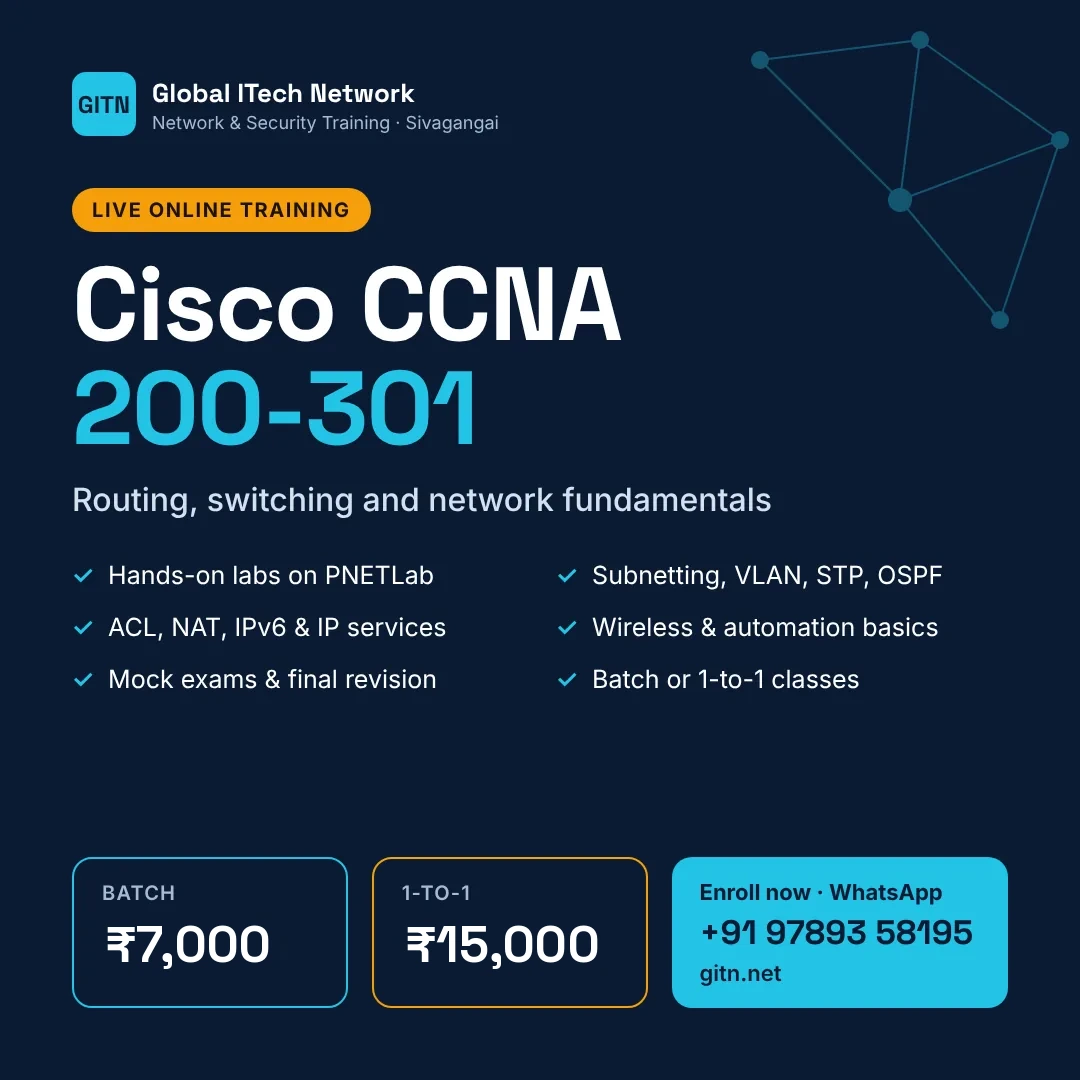
At Global ITech Network, CCNA is taught by a working network security engineer in live online classes. The syllabus covers the full 200-301 blueprint across 18 chapters, from networking fundamentals to automation, ending with mock exams and final revision.
- Hands-on labs on PNETLab for VLANs, STP, OSPF, NAT/PAT, ACLs and IPv6
- Practice questions, mock exams and a final revision round
- Batch training at ₹7,000 or personal 1-to-1 training at ₹15,000
Frequently asked questions
Is CCNA hard for beginners?
It is very achievable for beginners who study steadily and practise in a lab. The hardest parts for most people are subnetting and routing, and both become easier with daily practice.
How long does it take to prepare?
It depends on your background and study time. With regular classes and daily lab practice, most learners are ready within a few months.
Do I need to know programming?
No. The automation domain covers concepts such as APIs, JSON and configuration tools. You need to understand them, not write large programs.
How long is the certification valid?
Cisco certifications are valid for three years. You can renew by passing a qualifying exam or by earning continuing education credits.
Start your CCNA journey with GITN
Live online classes, your own lab practice and guidance from a working engineer. Message us for the next batch date.
Message on WhatsAppView CCNA syllabus and feesExam details are based on Cisco's published 200-301 CCNA exam information and v1.1 exam topics, checked in November 2026. Always confirm the latest fee and version on Cisco's website before booking.